When states adopt direct admission—an approach that simplifies the college search process by automatically admitting high schoolers who meet certain criteria—college enrollment tends to increase.
At least that’s what education researcher Taylor Odle says he sees in news articles he’s been following about direct admission. He cites evidence of its success in states such as California, Georgia, Minnesota, New York, and Wisconsin.
 “If you’re in a state and you see this (enrollment) trend line going down, and you implement direct admission and then it goes up … my gut is that that has something to do with direct admissions,” said Odle, an assistant professor of education and policy at the University of Wisconsin-Madison. “That’s why I think so many states are adopting these programs.”
With direct admission, colleges reach out proactively to students, offering them automatic admission based on high school data such as grade-point averages.
By offering admission before a formal application is submitted, schools streamline the process, removing barriers such as essays, application fees, and letters of recommendation. In many cases, states using direct admission have reduced the college admission process to a single form that yields responses from multiple institutions.
Interest in such programs is on the rise nationwide as states—and the colleges and universities within them—search for ways to boost flagging enrollment.
“With direct admission, colleges reach out proactively to students, offering them automatic admission based on high school data such as grade-point averages.”
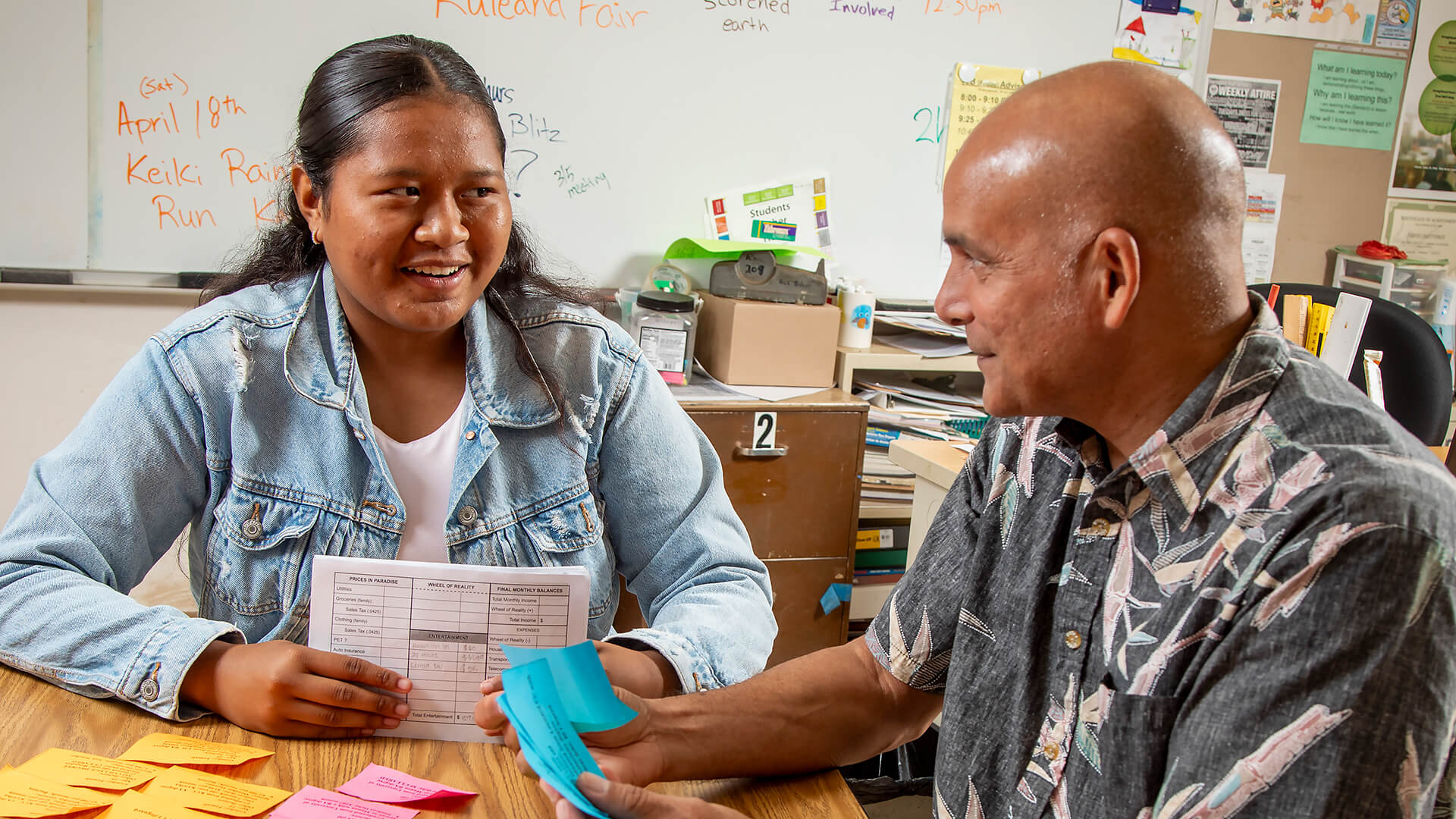
Idaho was the first to launch a statewide program in 2015. Since then, at least 14 other states have implemented them, according to the National College Attainment Network, an organization that works to make higher education more accessible. In this issue of Focus, high school seniors in three of those states—California, Hawaii, and Wisconsin—share their views about direct admission.
Despite the growth of direct admission programs, evidence of their effectiveness has been elusive. For instance, a 2025 study co-authored by Odle found that while students were 2.7 percentage points—or 12 percent—more likely to submit a college application through direct admission, they were not more likely to ultimately enroll.
An earlier study from 2022 looked at the effects of direct admission in Idaho and found that it increased first-time undergraduate enrollments by 4 percent to 8 percent but had “minimal-to-no impacts on the enrollment of Pell-eligible students.” Further, the enrollment gains occurred mostly at two-year, open-access institutions.
That’s where Odle’s latest research comes in. One of the nation’s top experts on direct admission programs, Odle is seeking what he calls “really good, rigorous research evidence” to determine whether such programs actually increase enrollment.
He is working on a controlled study to examine the effects of TN Direct Admissions. That program, a recently launched pilot in Tennessee, is said to be the first to pair direct admission with financial aid. The study seeks to determine whether providing clear financial aid information, in addition to direct admission, increases the likelihood of college enrollment compared to receiving only direct admission or receiving nothing at all.
Odle said his research—which is funded by Lumina Foundation, the Kresge Foundation, Bloomberg Philanthropies, the University of Wisconsin, and Making Caring Common at the Harvard Graduate School of Education—should yield a more granular view of the benefits of direct admission. He is especially interested in how those benefits are distributed among various demographic groups.
“So, it’ll finally be a place where we can say: ‘It didn’t work for this group of students. Does it work generally and for what people?’ And then: ‘How does it come to work?’” Odle said.
Reliable evidence of direct admission’s effectiveness is increasingly important, as a growing number of states have adopted or are about to roll out statewide programs.
For students such as Anabia Farooq, a Milwaukee resident born in Pakistan, direct admission served as a backup plan in the quest to get into more selective colleges. For her, those more selective schools included the University of Wisconsin-Madison, which like many flagship universities in direct-admit states doesn’t participate in the direct-admit program. But other high school seniors used direct admission as a lifeline. For these students, including Bartolo Bacilio Pedro of Riverside, California, an immigrant from Guatemala,
it was essentially the only action taken to secure education beyond high school.
Direct admission gives students from lower-income families extra support and encouragement in the college admissions process. It also benefits institutions—as a recruitment strategy that can help boost funding.
Discussions with system leaders and others suggest both advantages are appealing.
“At the end of the day, we want students to go to college,” said Tomás D. Morales, president of California State University-San Bernardino. His institution participated in a pilot direct admission program in Riverside County that is set to go statewide later this year.
“If they decide to come to Cal State-San Bernardino, that’s fabulous,” Morales said. “But at the end of the day, we want students to go on to college” for the individual and societal benefits it affords. He cited research showing that college graduates earn more over the course of their lives and are more civically engaged. He also said graduates can spark “a college-going cycle” that affects entire families.
“Their younger siblings see their older brother or sister getting a college degree, and they say, ‘Hey, I can do that, too.’”
Morales and other educators also say direct admission programs encourage students who may doubt whether they have what it takes to succeed in college or whether college is worthwhile for them.
But occasionally education leaders acknowledge that a major driver of direct admission is the effort to boost college enrollment and help their institutions survive. And for many colleges and universities, survival is threatened by growing cynicism about the value of a college degree and by the dwindling pool of high school graduates from which to recruit.
“There’s a reason direct admission came around when it did,” said Rafik Mohamed, provost and vice president for academic affairs at Cal State-San Bernardino.
He pointed out that the Cal State system entered into a five-year compact with Gov. Gavin Newsom in 2022 that ties state funding to enrollment. The direct admission pilot in Riverside County began in the 2025-26 academic year.
“We have not, as a system, fulfilled our obligation to the compact in terms of overall enrollment,” Mohamed said. “We’re not far off, but we’re not where we agreed to be when the governor and the chancellor’s office entered into this funding compact.”
An internal progress report says the system was projected to enroll the equivalent of 392,500 in-state, full-time students during the 2025-26 academic year, a total which would exceed the system’s enrollment target for the first time in four years. But the same report says those figures are only estimates. It also notes that the chancellor’s office and university leaders are working together to maximize state resources to ensure that the CSU system is positioned to meet funded enrollment targets in the 2025-26 and 2026-27 academic years.
In other words, it’s too early to accurately judge direct admission’s effectiveness in boosting enrollment in California. In fact, some early signs suggest it may not be having the intended effect.
CalMatters, a nonpartisan and nonprofit news organization, reports that, following the direct admission pilot in Riverside County, about 1,500 more students applied to Cal State campuses in 2025 than in 2024. However, actual enrollment increased by only 136 students.
“The data for Riverside County reviewed by CalMatters suggests that more applicants and admitted students through an automatic admissions policy doesn’t translate into more enrolled students,” a December article about the matter states. The article suggests the system “will have to work harder to convert admitted students into ones who actually enroll.”
Clearly, enrollment data in California and in other states that are just beginning their direct admission programs will merit close attention in coming years.
Still, even if research never establishes a strong causal connection between direct admission and higher enrollment, Odle said such programs are valuable because they benefit students.
“Even if we had the most rigorous research study and we saw that direct admissions didn’t increase enrollments, isn’t simplifying the process—telling people about college opportunities—still better?” he asked.
“I would say, ‘Yeah.’
“Do we need to show that it is a silver bullet? Maybe,” he added. “But maybe, at the end of the day, just reinventing the process to make it easier for everybody, that seems to make a lot of sense to me, too.”
Writing | Jamaal Abdul-Alim
Editing | David S. Powell and Stephanie Wang
Editorial assistance | Ruth Holladay
Photos | Shawn Spence
Video Reporting: Grace Trahan
Video Production: Michael Jensen
Design | IronGate Creative