
Despite skills-based hiring shifts and the rise of AI, employers still value college degrees
For years, the future of work has seemed to be pointing away from the college degree.
Companies have dropped degree requirements from job postings. States and employers have embraced skills-based hiring. Artificial intelligence is beginning to reshape entry-level work. And recent college graduates are entering a labor market that has become noticeably harder to crack.
It would be reasonable to assume that employers are beginning to care less about college.
They aren’t.
A new Lumina Foundation Gallup survey of 2,500 U.S. hiring decision makers finds that 60 percent have a great deal or quite a lot of confidence in higher education.
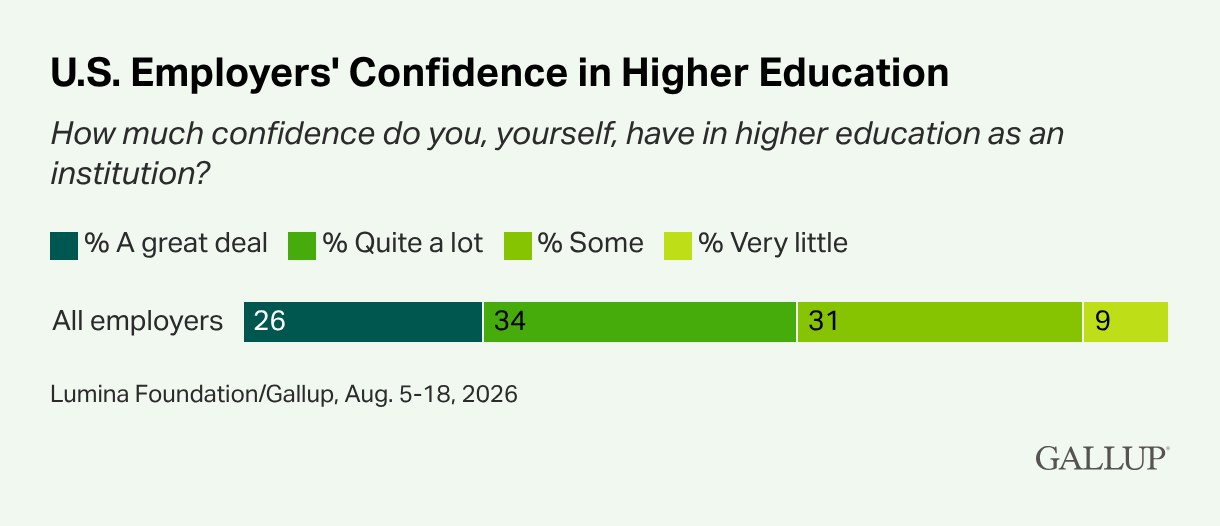
That number becomes even more striking when compared with the public. Just 38 percent of Americans say they have that level of confidence in higher education, down from 57 percent when Gallup first asked the question in 2015.
But employers are not simply offering an opinion about colleges and universities. They are also telling us what they look for in candidates.
A majority say they would prefer to hire a candidate with a college degree, even when the job does not require one. Sixty-eight percent prefer a candidate with at least a bachelor’s degree, while 71 percent prefer someone with at least an associate degree.
Even artificial intelligence, often portrayed as the force that could finally weaken the degree’s hold on the labor market, is not pushing employers in that direction. Nearly half of hiring decision-makers (48 percent) expect AI to make college degrees more important over the next five years. Just 26 percent think degrees will become less important.
The public sees AI differently: 46 percent of Americans expect it to make degrees less important, while 20 percent expect it to make them more important. That is not the future-of-work story that many people expected.
For years, the conversation has suggested that the labor market is moving from degrees to skills. But removing a degree requirement and reducing the value employers place on a degree are not the same thing.
Research from Harvard Business School and the Burning Glass Institute found a similar disconnect. After examining millions of job postings and hiring records, researchers found that removing degree requirements produced only a modest increase in hiring workers without bachelor’s degrees.
Employers were changing what they said they required faster than who they hired.
An employer can say a degree is optional but still prefer the candidate who has one.
That distinction matters because the labor market is sending young people mixed signals.
According to the Federal Reserve Bank of New York, unemployment among recent college graduates was about 5.6 percent in the second quarter of 2026, while underemployment reached 42 percent. Many graduates are struggling to find work that fully uses their education, understandably intensifying questions about whether college still pays off.
Yet the broader economic picture looks different. In 2025, workers 25 and older with bachelor’s degrees had median weekly earnings of $1,578, compared with $966 for workers whose highest credential was a high school diploma. Unemployment was also substantially lower among bachelor’s degree holders.
The problem may not be that employers have stopped valuing degrees. It may be that the economy isn’t producing enough strong entry points for the people to earn them. That is a different and more complicated problem. It also explains why the new employer data should not simply be read as a victory lap for higher education.
Employers can value a degree and still question whether graduates are fully prepared for the workplace. Earlier Lumina Foundation Gallup research found that only 54 percent of employers agreed that colleges and universities were graduating students with the skills their businesses needed, while about seven in 10 said recent graduates required a moderate amount or a great deal of additional training to be effective in their roles.
Employers appear to be saying two things at once. We still want the degree. We also want more from the people earning it.
That tension may be especially important in the age of AI.
The common assumption has been that artificial intelligence will reduce the need for formal education because technology can increasingly perform tasks once done by college-educated workers.
Employers may be considering another possibility.
Nearly half believe AI will make degrees more important, not less. The survey does not tell us precisely why. Employers may anticipate greater demand for technical expertise, judgment, and adaptability. Or degrees may remain a useful signal of someone’s ability to learn and make decisions in rapidly changing workplaces.
Whatever the reason, the finding complicates predictions that AI will quickly dismantle the relationship between education and work.
Students and graduates continue to see value in that relationship.
Undergraduate enrollment also rose 1.3 percent in spring 2026, reaching 15.5 million students, according to the National Student Clearinghouse Research Center. But these signs of continued demand do not erase the difficulties graduates face when they look for work.
Colleges need to connect learning more clearly to the skills employers seek and help students gain experience before graduation. Employers, for their part, need to create stronger entry points for new graduates and make sure a degree preference does not become an unnecessary barrier when a job does not require one.
At a moment when public confidence in higher education has fallen, employers are sending a remarkably different signal. They continue to prefer degrees, express confidence in higher education, and expect college credentials to matter in an economy being reshaped by artificial intelligence.
That doesn’t mean colleges can stand still. It means they have something valuable to build on.
The national conversation suggests the economy is moving beyond the college degree. The people doing the hiring are telling us otherwise.