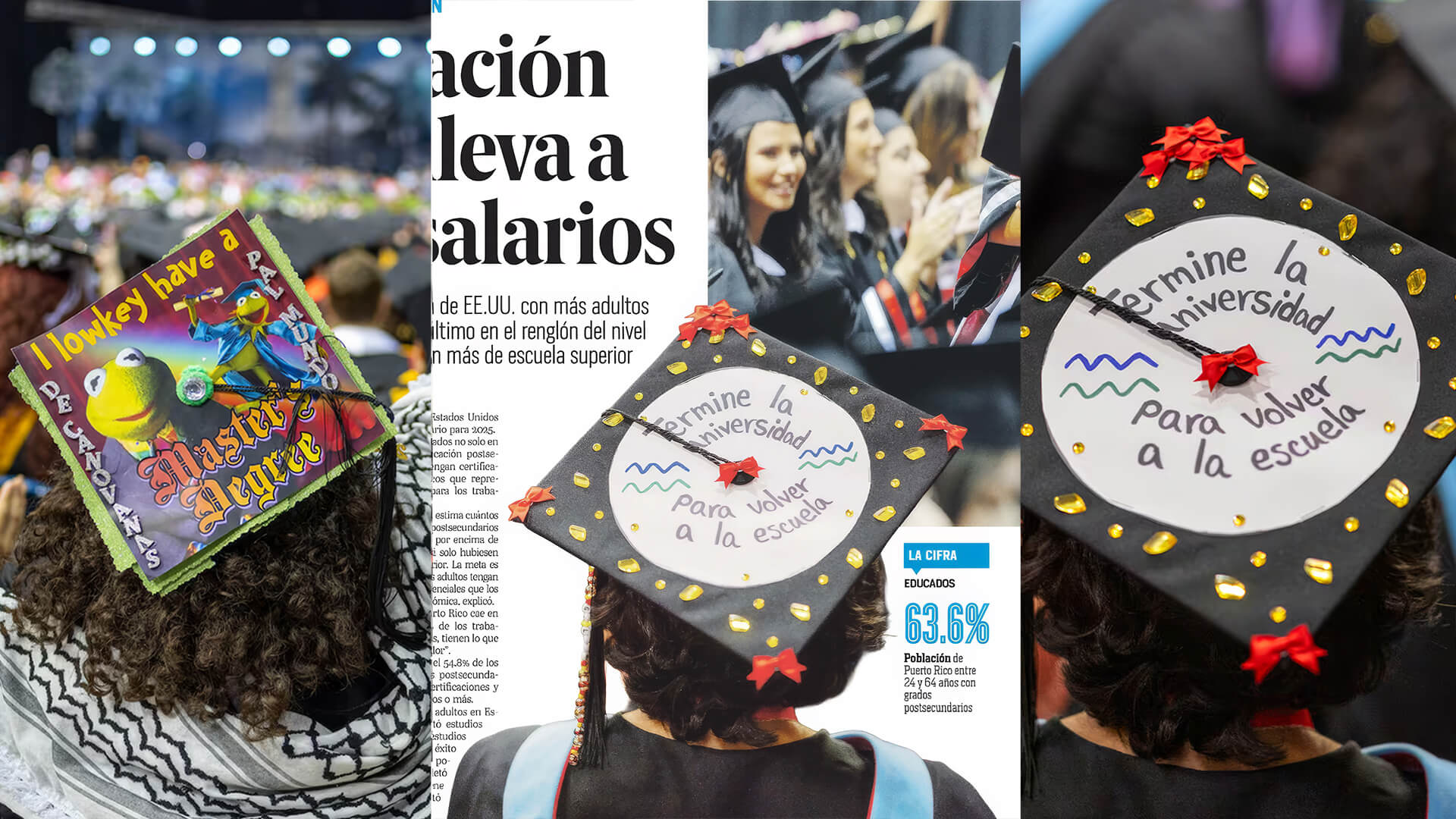
An analysis ranks the island as the seventh U.S. jurisdiction with the highest percentage of people holding postsecondary credentials, but dead last in economic return.
By Keila López Alicea
Puerto Rico is the seventh U.S. jurisdiction with the highest percentage of adults ages 25 to 64 who hold postsecondary credentials, with 60.1% of that population having completed a credential beyond a high school diploma, according to a study by Lumina Foundation.
The island rises to fourth place among the 50 states and Washington, D.C., in academic attainment when looking only at adults ages 25 to 34, based on 2024 data from the latest A Stronger Nation report. In Puerto Rico, 63.6% of people ages 25 to 34 hold postsecondary credentials.
“That reflects strong participation in all kinds of education beyond high school and really shows this clear focus, this clear cultural emphasis on education in Puerto Rico. And it shows that, as we have said, getting more education is really important,” said Lumina Foundation Vice President for Impact and Planning Courtney Brown.
Lumina is a U.S. nonprofit organization that, since 2009, has focused on promoting higher education nationwide. At that time, it set a goal of increasing the share of adults in the United States with a college degree to 60% by 2025.
Brown explained that the organization is now focused not only on expanding access to postsecondary education, but also on ensuring that people earn certificates or degrees that carry economic value for workers.
With that in mind, its annual report estimates how many workers with postsecondary education earn wages above what they would likely make if they had completed only high school. The goal, she said, is that by 2040, 75% of adults will hold college degrees or credentials that lead to economic prosperity.
On that measure, however, Puerto Rico ranks last. Only 25% of workers on the island between ages 25 and 64 have what Lumina calls “credentials of value.”
Across the United States, 54.8% of adults have completed postsecondary education. Of these, 7% hold certificates and 47.8% hold associate degrees or higher.
Meanwhile, 43.6% of U.S. adults who completed postsecondary education have credentials that are expected to lead to economic success. Of these, 7% hold certificates, 5.1% completed associate degrees, 18% hold bachelor’s degrees, and 13.5% completed graduate studies.
Access to education
The report, published in February, highlights that 49.1% of adults on the island hold associate degrees or higher, while 11% hold certificates, whether from short-term programs or professional certifications.
“What we are seeing in Puerto Rico with respect to educational attainment is quite remarkable. I would say Puerto Rico stands out as having one of the highest levels of educational attainment compared with many states,” Brown said in a video interview.
“It’s amazing. Sixty-four percent of people between ages 25 and 34 have a degree, certificate, or workforce certification, which is impressive for the U.S. region. And what is really interesting is that, in 2009, only 34% of Puerto Ricans had a degree. That is a huge change in 15 years and, to me, reflects strong participation in all kinds of education beyond high school,” she added.
Lumina states that the percentage of adults in Puerto Rico with postsecondary education increased by 25.9 percentage points from 2009, although at that time the organization did not count short-term programs. By 2019, when the same criteria were being measured, 52.9% of adults on the island had postsecondary credentials.
The study notes that Guaynabo is the municipality with the highest percentage of adults ages 25 to 64 with postsecondary credentials, at 62.5% of the population. It is followed by Trujillo Alto (60.6%), San Juan (58.3%), Hatillo (57.9%), and Carolina (57.1%). The municipality with the lowest percentage is Maricao, where 21.2% of the adult population holds a postsecondary credential.
The analysis in the A Stronger Nation report is based on data from the U.S. Census Bureau, the U.S. Bureau of Labor Statistics, the Integrated Postsecondary Education Data System (IPEDS), and the Georgetown Center on Education and the Workforce, among others.
The value of education
Brown said that, internally, the team that prepared the report was struck by the gap between Puerto Ricans’ educational attainment and their wages. “It’s a remarkable story of such high educational achievement in terms of access to education, but a lack of credentials of value. My interpretation is that the reason is that we are using the national wage. How much does a person with a high school diploma earn in the mainland United States? In Puerto Rico, it is very different,” Brown said.
Lumina defines a credential of value as one that leads to earnings at least 15% above the national median annual wage of a high school graduate. The median is not the same as the average; it refers to the midpoint between the highest and lowest wages.
The U.S. Bureau of Labor Statistics projected that the median annual wage in 2024 for a worker over age 25 with a high school diploma was $48,360, according to data published in August 2025.
Adding 15% to that amount, under Lumina’s methodology, produces an annual wage of $55,614. The median annual household income in Puerto Rico in 2024 was $27,213, according to Census Bureau data.
Even under modified criteria, wages in Puerto Rico remain much lower. The National Center for Education Statistics reported that, in 2022, the median annual income for adults ages 25 to 34 with only a high school diploma was $41,800.
“We have recognized that earning an academic degree by itself is not enough. We need more people to enroll, yes, and we need more people to succeed and reach their goals. But that is not the full story, because we need to make sure people earn credentials that lead to real economic opportunities, good jobs,” Brown said.
“We are analyzing whether people really see a return in the labor market from earning that credential, and this is based on a lot of feedback from people who are losing confidence in higher education. They say degrees do not lead to good jobs and things like that, so we thought, ‘they’re right.’ If you are going to invest time and money in earning a credential, it should provide value,” she added.
Brown estimated that the story of credential value would look different if the analysis were based on local wages. “Wages are lower overall in Puerto Rico, and the cost of living is very different,” she said.
“I think it would still be a very positive story for Puerto Rico. And it’s interesting because, when we set the goal, we had several states, mainly in the South, say: ‘I love this goal, but don’t compare me with the national average. Compare me with my state, because in Louisiana we have a lower percentage of high school graduates than you do in Massachusetts.’ And we considered that idea. Should we do something like that? But we have a national goal, so we wanted to keep it tied to a national average,” she said.
She added that one of the main objectives of A Stronger Nation is to encourage discussion and support the development of public policy that strengthens access to education at the local level.
“We encourage every state to set its own goal. We want states to set their own goals and work on them, compare themselves with their own average if that makes more sense to them. And that is why I think it makes more sense for Puerto Rico to do the same, because it really cannot compete with Massachusetts or the District of Columbia. It’s something very different,” she said.
This article was originally published El Nuevo Dia.