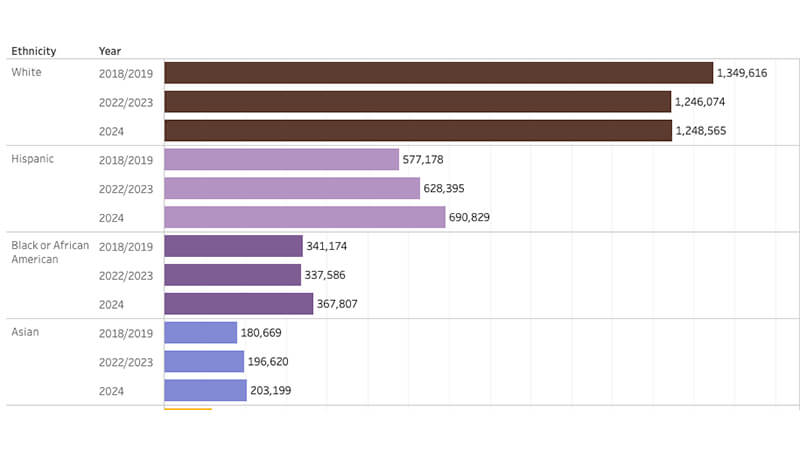
See the enrollment outcomes at more than 3,000 institutions in 2024, the first year affected by the Supreme Court's elimination of race-conscious admissions compared to 2018 and 2019. Enrollment data are drawn from the Integrated Postsecondary Education Data System.
This document details the methodology for counting certificates and certifications that are used for reporting beginning in 2024 (applies to 2023 data and forward). Certifications rates are developed using the CPS but directly align with how degrees are evaluated under Lumina Foundation’s revised goal. Certificate rates are developed through a multi-step process that estimates the…
While public confidence in higher education has declined sharply in recent years, current students and graduates report far more optimistic experiences. The College Reality Check: What Students Experience vs. What America Believes report from Lumina Foundation and Gallup examines this divide, highlighting public skepticism alongside the positive outcomes described by those on campus and beyond.
Class Action’s new report, The Future of Fair Admissions: A First Look at College Enrollment Outcomes After the End of Affirmative Action, compares first-time enrollments in 2022 and 2023 to enrollments in 2024 at over 3,000 colleges and universities for more than 3 million freshmen.
Noncredit workforce education has emerged as a vital yet underexamined pathway in American higher education. Accounting for an estimated 40% of community college enrollment nationwide (American Association of Community Colleges, 2024), noncredit programs attract millions of adult learners annually. These programs serve diverse needs, providing occupational training geared toward adults seeking skills for new or…
Research has long shown that graduation likelihood is linked to a student’s financial resources, family’s educational background, gender, and ethnicity. But Lumina-funded research now reveals that an institution’s actions and culture matter as well.
The 2025 update to HCM's landscape analysis of state investments in short-term credential pathways. The latest and most comprehensive analysis identifies 111 active state-funded initiatives across 34 states.
California students now have more options to take courses offered by institutions that are geographically distant from them, expanding the course-taking landscape for students statewide. This brief explores how the growth of online course taking over the past 10 years has affected the geography of enrollment, specifically the choices students make about where they take…
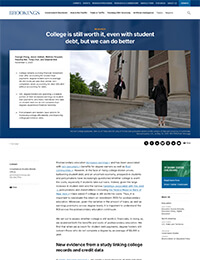
College remains a strong financial investment even after accounting for student loan payments: degree holders earn on average $8,000 more per year than similar non-completers when accounting for debt ($10,400 without accounting for debt).
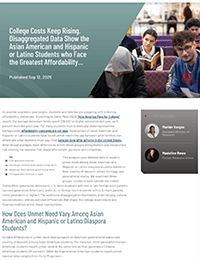
For many students from historically underrepresented backgrounds, college affordability concerns are not new. Generations of Asian American and Hispanic or Latino students have faced unmet need—the gap between what families can afford and what students must pay—that persists long after arriving in the United States. When broad averages mask differences within these groups, policymakers and…
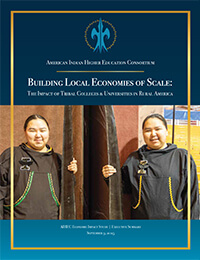
The nation’s 35 tribal colleges and universities create value in many ways. For example, TCUs play a key role in helping students increase their employability and achieve their individual potential. TCUs provide students with the education, training, and skills they need to have fulfilling and prosperous careers. TCUs are also places for students to meet…
Despite the Trump administration’s continued assault on colleges and universities, Americans’ confidence and favorability toward colleges and universities has increased from recent lows.
Dual enrollment is a proven strategy for aligning education with the needs of a rapidly changing workforce. By allowing high school students to earn college credit—particularly in career-aligned fields—these programs support smoother transitions into postsecondary education and employment.
Nearly three-quarters of college presidents (74 percent) say they are “extremely concerned” about the Trump administration’s impact on higher education, according to a survey from the American Council on Education.
The U.S. economy is facing a skills shortage crisis in critical occupations, according to new research from the Georgetown University Center on Education and the Workforce. From 2024 through 2032, 18.4 million experienced workers with postsecondary education are expected to retire, far outpacing the 13.8 million younger workers who will enter the labor market with…