
In 2025, the National Center for Education Statistics (NCES) didn’t just get a trim. It got a buzz cut. The office already operated efficiently compared to other federal statistical agencies, but the cuts they experienced were drastic and shortsighted.
Did the NCES need to improve? Absolutely. But it was functioning effectively when the Department of Government Efficiency (DOGE) made cuts, reducing its staff from nearly 100 to three and terminating nearly three-quarters of its contracts.
Reform was already in motion
Before this move, NCES had already begun to make needed reforms. In response to a 2022 National Academies of Sciences, Engineering, and Mathematics (NASEM) report recommending changes, NCES put a strategic plan and advisory committees in place. Instead of allowing those reforms to take hold, DOGE began making cuts.
Several major long-term studies that track students over time were cancelled. These studies helped us understand how students move from high school to college, what their college experiences are like, and what happens after they earn a bachelor’s degree. The official explanation for ending them was that the department can choose whether to conduct longitudinal studies.
The good news is that the Integrated Postsecondary Education Data System (IPEDS) is still operating, as is the National Postsecondary Student Aid Survey (NPSAS), which helps track how billions of federal financial aid dollars are used.
What we lose when the data disappears
Because federal law prohibits the creation of a national student-level database, NPSAS and IPEDS aren’t optional. They’re the foundation of what we know about how students engage with college.
One discontinued study—the Beginning Postsecondary Students Longitudinal Study (BPS)—made those data better. For example, BPS data showed that to truly measure success for students attending part-time, we need to look at their outcomes over eight years rather than just four. That finding led to improvements in how IPEDS reports outcomes, including better insight into how Pell Grant recipients are doing. Longitudinal studies also helped us understand the experiences of veteran students. Without them, we lose insight into how these students are faring and how best to support them. Without this data, we cannot responsibly design policies to serve those who have already served the nation.
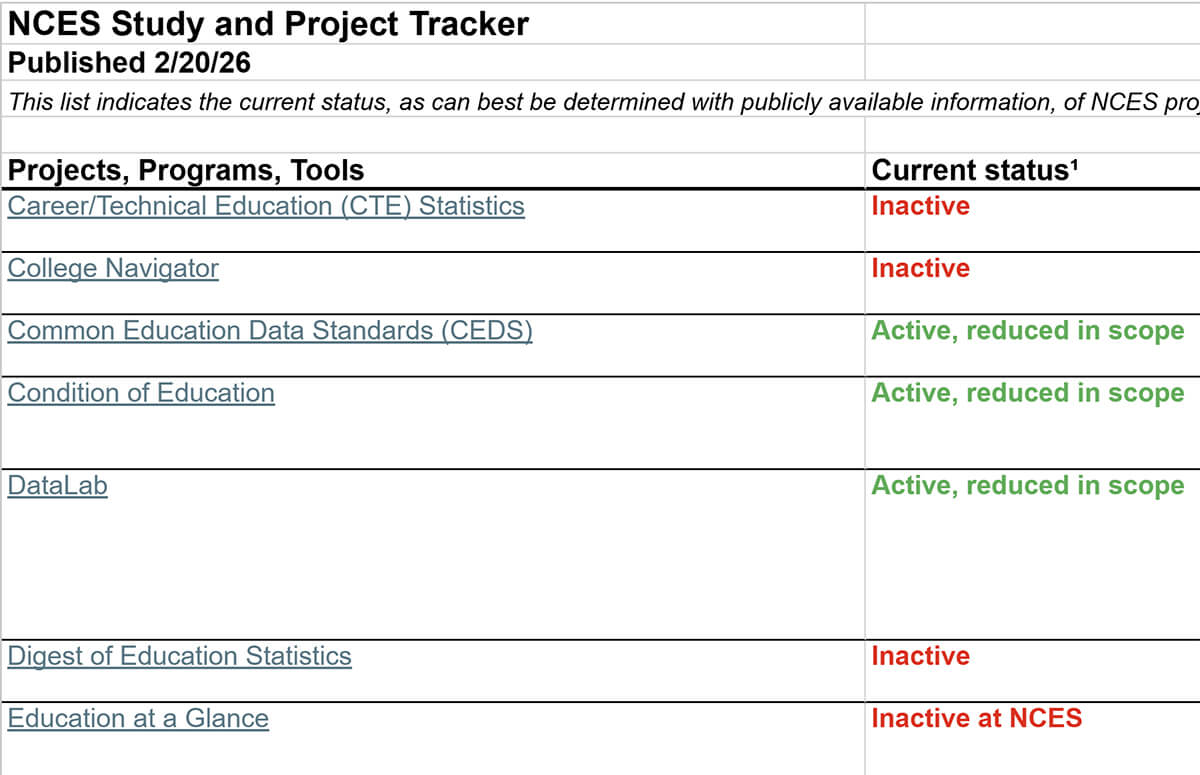
To bring transparency to this moment, Lumina, in partnership with the American Statistical Association, is supporting a tracker to keep us all up to date on NCES data collections. In late February, it showed that:
- Of 33 active NCES data collections, such as IPEDS, reported in early 2025, 16 are now inactive, 15 are active (though four are reduced in scope), and the status of two is unknown.
- Of the 16 NCES reports produced, just five are active, all reduced in scope. That leaves 11 inactive products, including College Navigator, Career and Technical Education (CTE) Statistics, and the Digest of Education Statistics that convert data collected into valuable information for decision making.
- The State Longitudinal Data Systems (SLDS) Grant program is inactive, hampering state efforts to be repositories of data that may be missing from the federal government.
A second chance to rebuild, the right way
Although NCES might never return to what it once was, we might be seeing some regrowth. This month, the department has grown to 11 staff members. And in January, it signaled possible interest in reviving key longitudinal studies by asking for cost estimates as part of planning for the 2028 NPSAS study, though their return is not guaranteed.
People invested in NCES agree that it needed—and still needs—improvement. The irony is that improvements were already underway before the drastic cuts. This moment creates an opportunity to rebuild NCES thoughtfully. It’s a vital federal agency that supports a central pillar of our country’s strength: educating and training its people.
Efforts to rebuild are underway. But data systems don’t grow back overnight. Rebuilding NCES isn’t about restoring what it was. It’s about ensuring the nation still has the evidence it needs to shape its future.