We know that education is a powerful tool for opportunity. But with rising college costs and more students relying on loans, this pressing question remains: Is college still worth it?
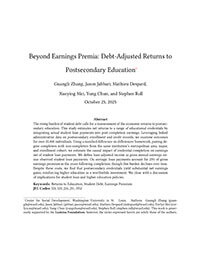
A new study from our partners at the Center for Social Development at Washington University in St. Louis sheds light on this question using a first-of-its-kind approach—measuring debt-adjusted earnings. Rather than just focusing on income gains from a college degree, this method accounts for what students actually keep after paying back student loans.
Education still pays, but loans still take a bite
The findings are striking:
- Graduates earn about $10,400 more annually than their peers who started college but didn’t finish.
- After accounting for student loan payments, that advantage drops slightly to $8,000.
- However, loan payments consume about 23 percent of earnings premia, which is substantial—particularly for recent graduates who often incur new expenses (e.g., transportation, housing, etc.) with relatively little savings.
It’s important to note that the share of income going to loans declines over time as graduates’ earnings rise, underscoring that the value of education increases with time.
One size doesn’t fit all
Not all returns are equal. The study highlights significant differences based on a student’s:
- Major (STEM fields see higher returns)
- Race/Ethnicity (Hispanic graduates see lower returns and higher proportions of debt)
- Credential or degree level
Those who leave school with debt but no credential or degree are particularly at risk, facing the financial burden of loans without the earnings boost of a credential. Research shows that by 2031, 72 percent of all jobs will require at least some form of postsecondary education or training.
Better policies, smarter investments
These findings challenge recent federal proposals to cut off student loans to programs where graduates don’t meet earnings thresholds. This approach overlooks a key point: Earnings growth trajectories matter more than static salary benchmarks.
Rather than restricting much-needed aid, we should:
- Expand access to income-driven repayment (IDR) plans
- Support non-degree credentials that show value
- Invest in affordability through initiatives like free community college and Pell Grant increases
- Make costs and outcomes more transparent for students
Where do we go from here?
Education should be a path to upward mobility, not financial distress. Data-driven research like this can help decision-makers design smarter, fairer policies and ensure that all students can make informed choices about the most productive ways to learn and earn.
Yes, college is still worth it. But with better policies, smarter investments, and clearer information, we can make it worth even more.