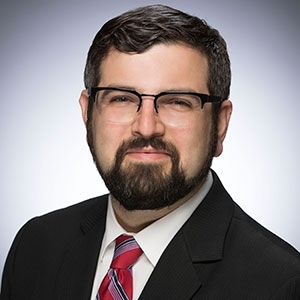
Dakota Pawlicki now leads the Talent Hubs work from CivicLab. He was previously a strategy officer at Lumina Foundation leading efforts focused on workforce education, particularly at community colleges.
Pawlicki’s prior work in designing and operating collaborative efforts to solve social challenges guides his work at Lumina. Serving in a dual role as director of strategic partnerships and projects, and as director of college access at Chicago Public Schools, he was responsible for developing and driving a city-wide vision of college access, support, and success for over 400,000 students. He also led the creation of the Chicago Higher Education Compact, an initiative with the expressed goal of increasing Chicago Public Schools’ four-year college graduation rate to 60% by 2025. Prior to that, he designed and implemented award-winning urban teacher preparation programs that place communities at the center, cultivating education talent through community partnership and immersion.
Pawlicki holds a bachelor’s degree in music education from Illinois State University and professional education license in K-12 music.
In 2023, the Supreme Court ruled in SFFA v. Harvard that race-conscious admissions policies violate the Equal Protection Clause of the Fourteenth Amendment and Title VI of the Civil Rights Act. The decision had an immediate impact on how colleges and universities determine who gets into their institutions. Three years after the ruling, researchers and […]
The demand for short-term credential programs is growing, and state leaders are responding. In 2025, a total of $8.1 billion was spent across 34 states to help students and institutions deliver high-quality, short-term education and training programs. This growing state investment, combined with Workforce Pell, has states contending with new issues: How will states approve […]
Workforce Pell takes effect on July 1 this year. The expansion of the entitlement program opens access to many more Americans seeking high-quality, short-term training programs that lead to in-demand jobs.
This month’s episode, Dakota investigates the creation of the A Stronger Nation data tool, and talks with Tom Harnisch of SHEEO on states that are making exemplary progress on attainment and how current state leaders are contending with ROI and changes to the social safety net.
In this deep-dive episode, we talk with experts and practitioners to better understand what makes a practice high-impact, the factors that drive institutional change, and the importance of authentically engaging faculty in the design and implementation of HIPs.
Reflecting on 2025, this show brings back key conversations that are sure to carry over into 2026. This episode revisits a conversation about American prosperity and Lumina’s new goal focused on credentials of value, a discussion about higher education’s role in shaping artificial intelligence, and a review of three states working to redesign admissions systems.