An estimated 5.5 million young Americans between the ages of 16 and 24 are neither enrolled in school nor serving as active participants in the workforce, according to a new report from the American Enterprise Institute.
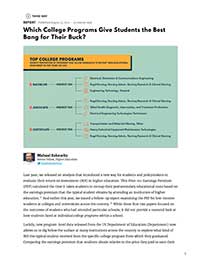
In 2020, we released an analysis that introduced a new way for students and policymakers to evaluate their return on investment (ROI) in higher education. This Price-to-Earnings Premium (PEP) calculated the time it takes students to recoup their college costs based on the earnings that the typical student obtains by attending.
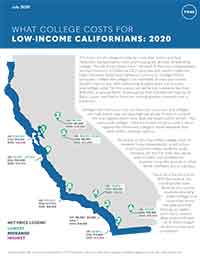
Despite facing the lowest tuition in the nation, a new report from The Institute for College Access & Success says low-income students attending a California community college typically pay more for college than students at the state’s costlier university systems. The study examines out-of-pocket costs faced by low-income students attending public colleges and universities across…
Despite concerns about the ongoing health pandemic, families remain optimistic about higher education and aren’t changing plans for the next academic year, says a report from Sallie Mae. The study includes statistics and trends on families’ attitudes toward the value of a college education, key considerations about what school to attend and how to pay…
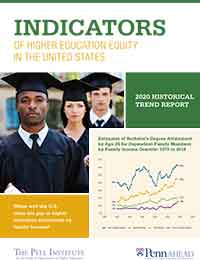
Equalization of institutional resources and quality does not mean a reduction in diversity or excellence, but it does mean embedding the consideration of equity issues in every step of institutional recovery and rebuilding.
Graduates of historically Black colleges and universities and Hispanic-serving institutions may be paying more to borrow and refinance their education loans, states this report from the Student Borrower Protection Center.
In a collaborative study of more than 40,000 Americans who started attending college, but did not finish with a degree, this report provides insights into the reasons they stopped out of college, and what could help them return.
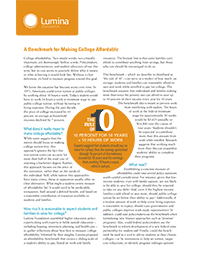
After grants, scholarships, and earnings from working 10 hours per week (a reasonable workload that won’t jeopardize academic success), students from low-income backgrounds still have to come up with thousands of dollars to cover the full cost at public colleges in just about every state. We call this the “affordability gap.”
College has become a risky proposition for students as well as taxpayers. Fewer than six in 10 students who start a degree will ever finish, which means that they won’t see a return on the money they’ve spent to attend—and if they took out a loan from the federal government, they might be left with…
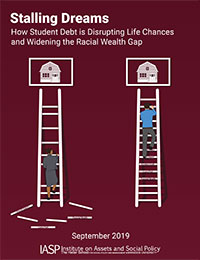
In an environment where average college tuition toll amounts to 25 percent of the typical family income, up from 9 percent in the 1960s, “Stalling Dreams” highlights the long-term impacts as more and more students take on student loans to complete their higher education.
Public flagship universities are often the most selective, rigorous, and well-resourced public schools in each state, and their important status and name recognition play an important role in raising the college-going aspirations of state residents. Flagships are well-positioned to promote social and economic mobility. However, increasingly high costs of attendance, declining state investment, and inadequate…
The principles outlined in the report will address the needs of the approximately 44 million Americans who currently have debt and the millions of future students who may take it on in the future. Addressing these three issues will advance the economic competitiveness and shared prosperity of our nation. At the same time, reauthorization of…
The Manhattan Institute's updated report comparing actual student expenses, based on data from the U.S. Department of Education’s National Postsecondary Student Aid Survey (NPSAS), with those recommended by Lumina's Rule of 10.
Attaining a higher education degree, especially for first-generation students, has long been recognized as a ladder to the American Dream. For many, however, the experience of borrowing to pay for their degree has been more akin to a nightmare.
As college costs rise, students face unprecedented financial barriers in their pursuit of higher education. A new report from the Institute for Higher Education Policy contends that free college programs in New York and Tennessee do little to remove affordability barriers for low-income students and instead allocate limited funding to middle- and, in the case…
Statewide free college initiatives, also known as “Promise” programs, are growing rapidly in states across the country. This report from The Century Foundation identifies six statewide Promise programs that were in operation through the Great Recession to see how they fared. This study also offers insight on the likely drivers of their sustained support to…
The report examines the numerous barriers preventing low-income students from enrolling and persisting in college, including concerns over high tuition and fees, lack of clarity on award amounts and duration, and a limited understanding of how financial aid works. "Making College Affordable" offers 11 best practices to institutions to help students pay for college and…
College affordability. Two simple words; two critically important, yet distressingly hollow words. Policymakers, college administrators, and student advocates all use this term, but no one seems to precisely define what it means or what achieving it would look like. Without a clear definition, it’s hard to measure progress toward this goal.
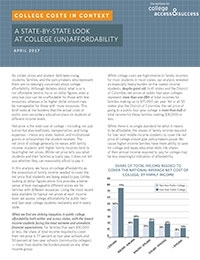
A report from The Institute for College Access & Success finds “striking inequities” in college affordability at two- and four-year public institutions, both within and across states. While college costs are high relative to family incomes for most students in most states, the lowest income students face the most extreme and unrealistic financial expectations, the…
A new report from The Manhattan Institute, American Enterprise Institute, and New America examines how much families pay for college and how they are financing those expenses, broken out by income level, race, and type of college. The findings suggest that 77 percent of undergraduates overpaid, on average, twice the recommended amount for college.
A report from the Institute for Higher Education Policy shows that college affordability varies dramatically between students with different family incomes, enabling wealthy students to attend essentially any college while effectively shutting out many of their peers. The study offers five recommendations for federal, state, and institutional policymakers to level the playing field and jointly…
Student employment is a critical and often-overlooked aspect of college life in the United States. Understanding the impact of student work—based on the number of hours worked—is important for students, parents, academic advisors, counselors, faculty, and administrative staff. Students, for instance, want to know how work affects their GPA and their overall satisfaction with college.…
Arizona — the subject of this issue of Lumina Foundation Focus magazine — is one of seven states that received multi-year grants from Lumina to build national momentum for enhancing productivity in higher education to get the state back on track. Arizona is using a four-year, $1.5 million Lumina grant to scale up the state’s…