Adding on to the largest national survey of prospective adult students. An updated view of demand, motivations, and barriers shaping postsecondary enrollment.
Of the 2.6 million college students who first enrolled in fall 2024, 85.8 percent returned to higher education in the spring for their second semester, according to new data by the National Student Clearinghouse...
This study provides a comprehensive account of how the full portfolio of major public benefit programs and financial aid shapes educational decisions and long-term earnings, tracing effects for our cohort across nearly three decades, from young adulthood through approximately age 40.
Class Action’s new report, The Future of Fair Admissions: A First Look at College Enrollment Outcomes After the End of Affirmative Action, compares first-time enrollments in 2022 and 2023 to enrollments in 2024 at over 3,000 colleges and universities for more than 3 million freshmen.
Noncredit workforce education has emerged as a vital yet underexamined pathway in American higher education. Accounting for an estimated 40% of community college enrollment nationwide (American Association of Community Colleges, 2024), noncredit programs attract millions of adult learners annually. These programs serve diverse needs, providing occupational training geared toward adults seeking skills for new or…
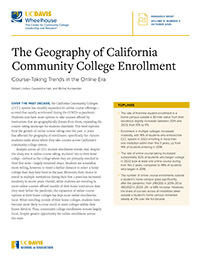
California students now have more options to take courses offered by institutions that are geographically distant from them, expanding the course-taking landscape for students statewide. This brief explores how the growth of online course taking over the past 10 years has affected the geography of enrollment, specifically the choices students make about where they take…
More than 82 million adults 25 years old and over have never enrolled in any postsecondary education, and another 43.1 million adults have some college credits, but no credential. Black, Hispanic, and Native American adults are disproportionately represented in both of these categories. But the fundamental structures and practices of colleges were not built with…
This study sheds light on the motivations, challenges, and successes of the strategies and practices used by a set of postsecondary institutions that have enacted institutional change in support of adult learners of color.
A recent survey found that, for the first time, a majority of Americans believe that a 4-year college education is not worth the cost. In addition, skills-based hiring—that is, recruiting and screening job candidates based on skills, rather than academic degrees—is becoming more common. At the same time, the U.S. Congress has been considering legislative…
Knocking at the College Door: Projections of High School Graduates has been an important resource for policymakers, decision-makers, researchers, and planners in education and workforce development since the first edition was produced in 1979. The 11th edition includes this comprehensive report and interactive data visualizations.
This brief shares student perspectives on making application decisions, financing college, and choosing to attend their particular institution, helping leaders to understand students’ enrollment decisions and address challenges to postsecondary access.
Policymakers and educators have promoted vocational certificate programs at community colleges as an effective way to meet labor market demands and help individuals leave low-wage work.
In partnership with Lumina Foundation and Achieving the Dream, Equal Measure explored strategies that community colleges are using to support adult learners. Our vignette about the Prioritizing Adult Community College Enrollment (PACCE) initiative highlights Colorado Mountain College’s promising progress for English as a Second Language (ESL) learners.
The Supreme Court's decisions on Students for Fair Admissions (SFFA) v. Harvard and SFFA v. UNC represent a serious step backward in the fight for racial equity and diversity in America that will harm all students and have serious repercussions.
This brief offers college leaders and admissions officials clear recommendations to ensure that their campus admissions are fair by rethinking recruitment strategies and demonstrated interest practices, and eliminating early decision and legacy admission.
This brief discusses the equity implications of requiring college applicants to submit an SAT or ACT score as part of their application for admission, considerations for college leaders examining test-optional polices, and ways in which test-free policies may address equity concerns related to standardized tests in college admissions. The brief concludes with recommendations for college…
This brief is focused on holistic review, a strategy in college admissions that assesses an applicant’s unique experiences alongside a range of indicators that include grades, extra curriculars, environmental context, among other factors. For admissions officers and college leaders, it is a powerful tool and a fairer and more thoughtful approach to reviewing student applications…
The Supreme Court's decisions on Students for Fair Admissions (SFFA) v. Harvard and SFFA v. UNC represent a serious step backward in the fight for racial equity and diversity in America that will harm all students and have serious repercussions.
Decades-long data show a persistent and troubling trend in higher education: Black student enrollments in U.S. postsecondary education have been declining precipitously since 2011, particularly at community colleges.
Data that identifies adult learners’ expressions of intention to enroll in college or training programs can help institutions and organizations more actively target, recruit, and support those learners who are most likely to enroll.