This Lumina Foundation profile looks at Illinois' effort to connect short-term credentials with anti-poverty strategy, workforce development, and economic mobility.
This Lumina Foundation profile examines North Carolina's work to make short-term credentials a stronger part of the state's education-to-workforce strategy.
This Citizens & Scholars report looks at the growth and early results of College Presidents for Civic Preparedness, a coalition of college presidents working to make civic preparation part of every student's college...
The Federal Work-Study (FWS) program provides more than $1 billion in support annually to more than 450,000 college students with financial need nationwide.
AIR’s Guide to Higher Education Federal Earnings Data, written by Dr. Alexandria Walton Radford of Sova, provides a side-by-side comparison of four federal sources of postsecondary earnings data: the Student Tuition and Transparency System (STATS), College Scorecard, Census Bureau’s Post-Secondary Employment Outcomes (PSEO) Explorer, and IRS-supported Secure Query System. The guide compares their purposes, earnings…
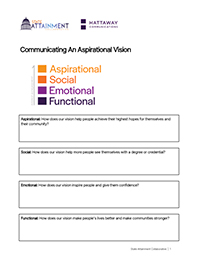
Across Lumina’s State Attainment Collaborative (SAC) cohort, states are making significant progress in bringing people together to advance value- centered attainment goals. See examples of state progress.
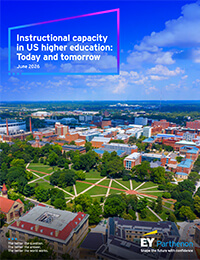
This report looks at whether U.S. colleges and universities have more teaching capacity than they are actually using. In simple terms, it asks: do schools have enough students to match the number of instructors, programs, classrooms, and academic resources they have built? The report finds that, in many places, the answer is increasingly no.
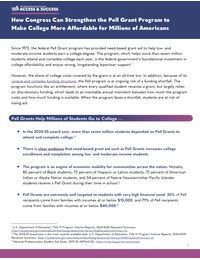
The Pell Grant program is the federal government’s most effective investment in college affordability, but the share of college costs covered by the grant is at an all-time low.